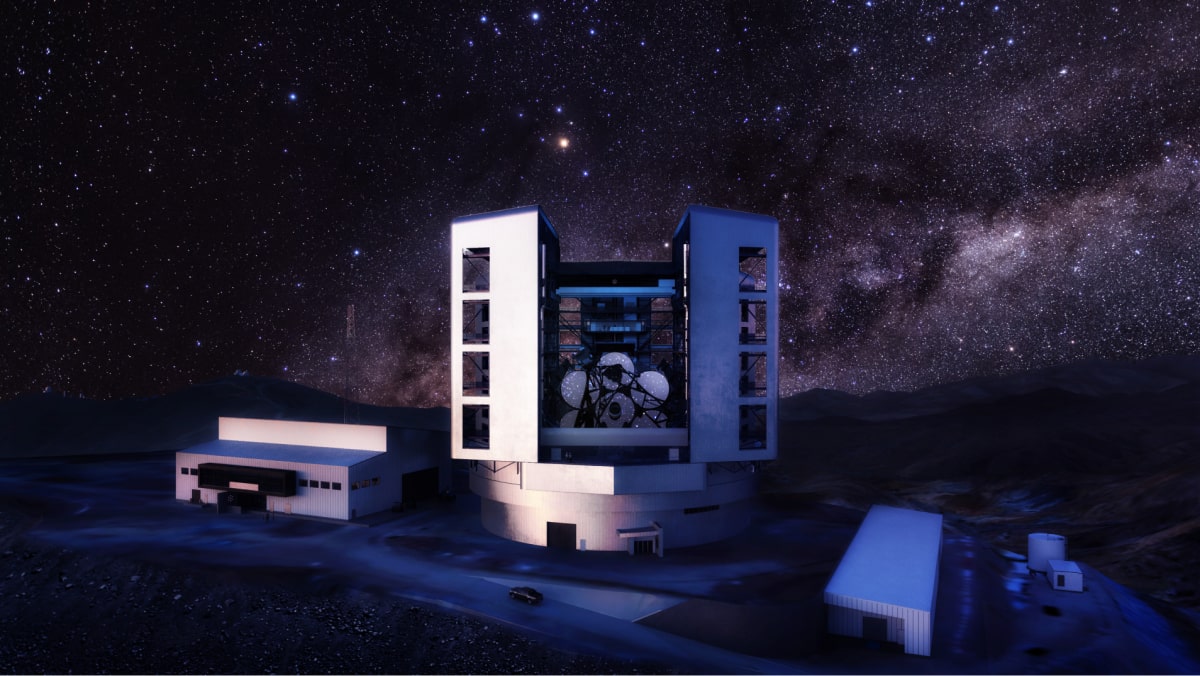
The Year in Photos 2025

2025 was a pivotal year for the Giant Magellan Telescope, marked by a clear path to complete construction by the 2030s. We welcomed a new consortium partner, achieved major milestones in the manufacturing and assembly of essential telescope subsystems, and advanced into the National Science Foundation’s Major Facilities Final Design Phase — one of the last steps before the observatory becomes eligible for federal construction funding.
This is our story of 2025 told visually.
January

We welcomed the Exploratorium to Chile as part of our National Science Foundation Broader Impacts work under Cooperative Agreement Award No. (FAIN) 2332336 to collaborate on an immersive, phenomena-based astronomy exhibition about the people, technologies, and science behind the Giant Magellan Telescope. The visit also included a tour of the NSF-DOE Vera C. Rubin Observatory ahead of its first light later in the year.
February

Work is advancing at the Center for Astrophysics | Harvard & Smithsonian on the Giant Magellan Telescope’s Large Earth Finder (G-CLEF) — an instrument roughly the size of a school bus. Designed to detect Earth-like exoplanets and search for signs of life, the Large Earth Finder has made major progress on its ultra-stable vacuum chamber and calibration systems.
March

Carnegie Science launched its 2025 astronomy lecture series at the Huntington Library with Dr. Rebecca Bernstein, Chief Scientist of the Giant Magellan Telescope, discussing how the telescope — under construction at Carnegie’s Las Campanas Observatory in Chile — will unlock unprecedented views of the Universe.
April

Our Universo Expansivo program hosted a professional development workshop for K–12 teachers at the Museo Interactivo Mirador (MIM) in Santiago, featuring multisensory astronomy lesson plans designed to make astronomy more accessible, including for learners with visual impairments.
May

The Giant Magellan Telescope achieved a key milestone with the delivery of two ultra-thin off-axis glass face sheets for its Adaptive Secondary Mirrors. These 2 mm-thick shells will flex in real time to correct atmospheric distortions, enabling unprecedented image resolution.
June

Prototype testing of the primary mirror support system successfully demonstrated its ability to adjust the mirror’s position, stabilize its temperature, protect it from seismic activity, and maintain its precise shape by mitigating mirror sagging as the telescope moves. This work was supported by the National Science Foundation under Cooperative Agreement Award No. (FAIN) 2332336. The successful validation followed a key milestone in June, when the NSF advanced the Giant Magellan Telescope into its Major Facilities Final Design Phase — one of the final steps before the observatory becomes eligible for U.S. federal construction funding.
July

Manufacturing and assembly of the largest telescope mount built in the United States continued at Ingersoll Machine Tools, supporting the Giant Magellan Telescope’s seven massive mirrors and instruments. Fabrication of azimuth track sections and disk segments progressed in Alabama, Michigan, and Illinois.
August

Fabrication is underway on the Giant Magellan Telescope’s Near-Infrared Spectrograph (GMTNIRS), developed by The University of Texas at Austin and the Korea Astronomy and Space Science Institute to study planetary systems, young stars, and exoplanets. Recent milestones include completed grating surfaces and the delivery of the first spectrograph cameras.
September

International collaboration remains central to the Giant Magellan Telescope, highlighted by a visit from Ambassador Hak-Jae Kim of the Republic of Korea to the construction site in Chile and the welcome of MIT as the consortium’s newest member, further strengthening one of the world’s largest public–private partnerships in science.
October

The Giant Magellan Telescope reached a key operational milestone with a successful external review of its Operations Plan, outlining how the observatory will function once construction is complete. The plan includes advanced simulation tools like the Builder of Observatory Behaviors (BOB), which models how people and systems will work together to ensure the telescope is ready to deliver science from day one.
November

Nearly 250 leaders gathered at Chicago’s Adler Planetarium for the inaugural Giant Magellan Gala, celebrating Dr. Walter E. Massey as he retires after ten years as chairman of the GMTO Board of Directors. The evening honored his lifetime of service and the legacy he leaves across science and education. The Gala marked the beginning of a new chapter of support as the project advances into the Final Design Phase with the National Science Foundation.
December

We began assembly and testing of the Adaptive Optics and Phasing Sensor (GAPS) Testbed at our new Pasadena lab, a key step toward validating the telescope’s adaptive optics strategy. This work is supported by the National Science Foundation under Cooperative Agreement Award No. (FAIN) 2438477.
The Universe Awaits® for 2026!
Feature Image Credit: Gonzalo Torres